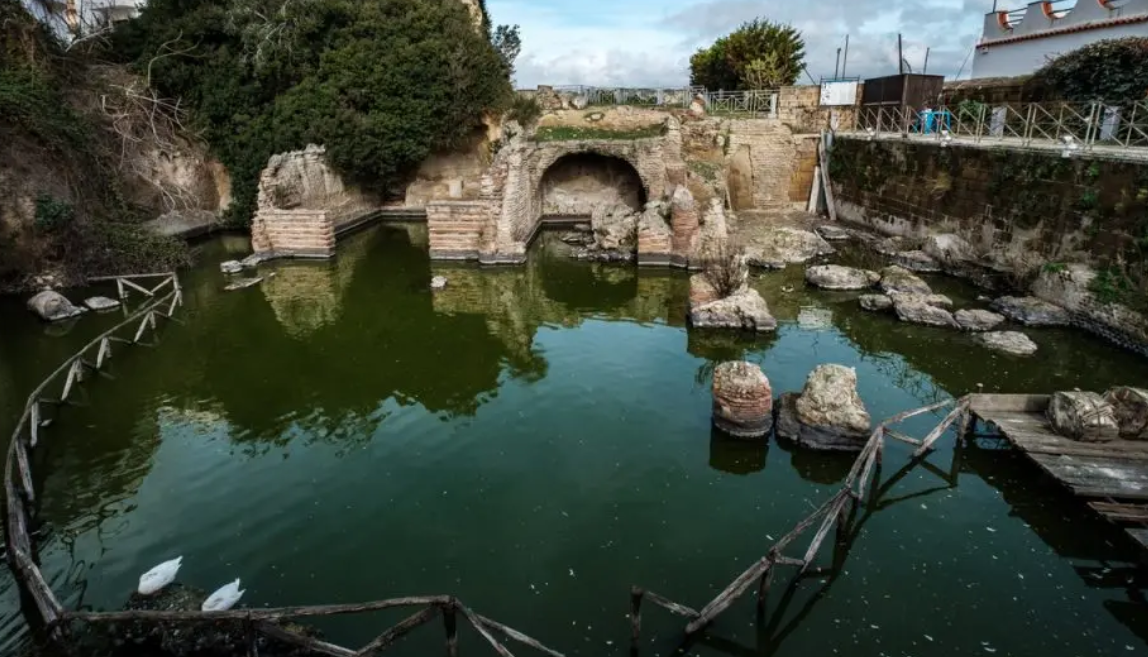
Located in Misenum, it was the seat of the imperial cult administered by freedmen. It was destroyed by an earthquake or bradyseism; today, the walls and floors remain, while the statues (including the equestrian statue of Domitian/Nerva) are at the Castle of Baia.
The Sacellum of the Augustales in Misenum is one of the most significant sites for understanding the connection between religion and political power in ancient Rome. Discovered almost by chance in 1968, this building was the place of worship dedicated to the emperors, administered by the college of "Augustal Priests," usually wealthy freedmen (former slaves) who found in serving the emperor a way to redeem themselves socially and demonstrate their loyalty to Rome. The building stood in the heart of ancient Misenum, near the theater and the forum.
The complex is divided into three spaces. The central one, the actual sacellum, featured a podium on which the divine statues of the emperors rested. The discovery was exceptional because the site was sealed by a catastrophic event (an earthquake or a violent bradyseism) that caused the ceiling to collapse, "freezing" the statues at the moment of collapse. Among the most famous artifacts discovered here (and now on display at Baia Castle) are the statues of Vespasian and the equestrian statue of Nerva, an extremely rare piece in which the face of Emperor Domitian was chiseled out and replaced with that of Nerva following the damnatio memoriae. Today, visitors can observe the architectural structure, the remains of the marble floors, and the statue bases, imagining the sumptuous decoration that once welcomed sailors and citizens of Misenum into this temple of imperial power.