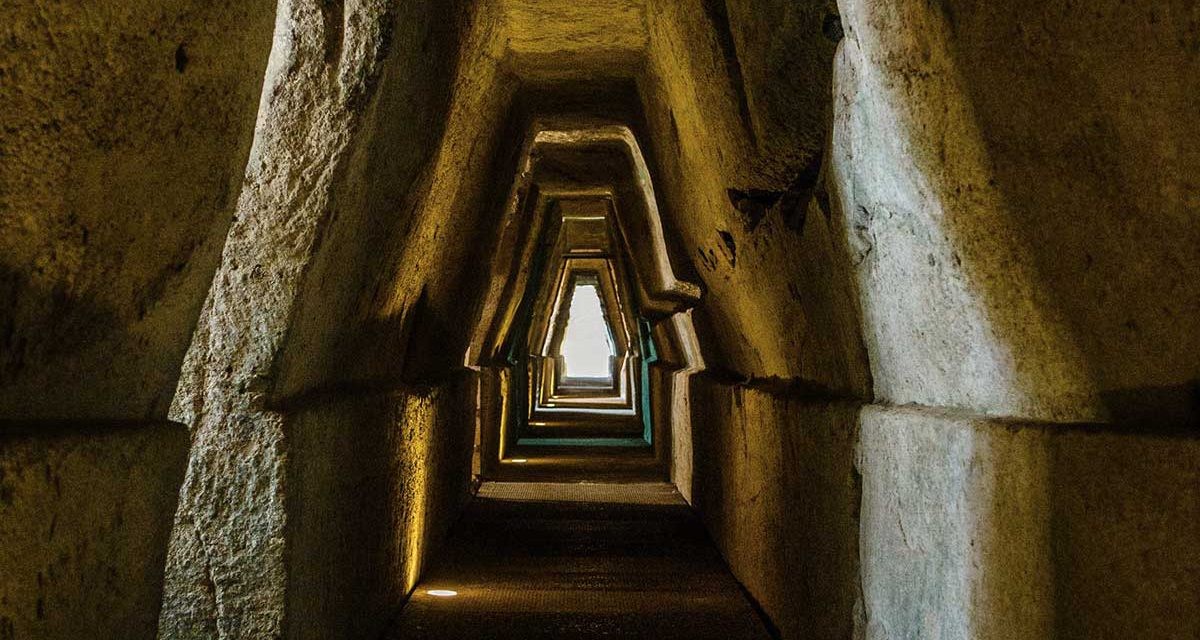
A 131-meter-long trapezoidal tunnel, famous for the prophecies described by Virgil in the Aeneid. The awe-inspiring nature of this place is indescribable.
The Sibyl's Cave is, without a doubt, the most fascinating and mystical place in the entire Archaeological Park of Cumae. Located at the foot of the Acropolis, this site represents the exact point where documented history and literary myth merge into a single, evocative underground passage. Its discovery, in 1932 by archaeologist Amedeo Maiuri, marked a momentous occasion: after centuries of research, the place described by Virgil in the Aeneid seemed finally to have re-emerged from the darkness.
Architecture and Structure: The Masterpiece of Tufa Cutting
Architecturally, the Cave is a rectilinear tunnel excavated entirely from the yellow Cumaean tuff, approximately 131 meters long. Its most striking feature is its trapezoidal cross-section, with walls that taper toward the top. This construction style, reminiscent of the Mycenaean structures of Tiryns and Mycenae, is not merely an aesthetic choice: the wedge shape gives the structure extraordinary static resistance against the thrust of the overlying earth, making it a masterpiece of ancient engineering.
Along the seaward side of the tunnel are six lateral openings, large windows or wells that filter natural light. These openings not only served for ventilation and lighting, but also had a fundamental acoustic function. It is said that the wind, blowing through these cracks, created sounds and hisses that could be interpreted as the voice of the deity itself. At the end of the long corridor lies the so-called oracular room: a rectangular room with a vaulted ceiling, equipped with three cisterns for ritual ablutions and a stone seat where, according to legend, the Sibyl sat.
The Heart of Myth: Virgil and the Cumaean Sibyl
The universal fame of this place is linked to Book VI of the Aeneid. Virgil describes the cave as a place "of a hundred doors" from which a hundred voices issued, the responses of the priestess Deiphobe, daughter of Glaucus. Aeneas came here, driven by the need to know his destiny before founding Rome, to ask the Sibyl to intercede with Apollo. The ritual was complex: the priestess, gripped by divine fury, wrote her oracles on oak leaves that the wind dispersed, forcing the supplicant to make a difficult interpretation.
The Sibyl was not just a prophetess, but a being on the border between the human and the divine. Loved by Apollo, she was granted the gift of living as many years as the grains of sand held in one hand, but she forgot to ask for eternal youth. Destined to perish over the centuries, only her voice remained, imprisoned for eternity within these tuff walls.
Historical Reality and Military Function
Although the mythical appeal is powerful, modern archaeology suggests a more pragmatic function. Scholars now believe the tunnel was excavated around the 4th-3rd century BC as part of a vast defensive system. Cumae, being the first Greek colony on the mainland, needed protected passageways to move troops and supplies from the Acropolis to the lower city without being seen from the sea. In Roman times, the site lost its military function and was repurposed, perhaps to host oracular cults, before becoming a burial site in the early Christian era.
Today, walking through the Sibyl's Cave means walking in the silence of a secular cathedral. The light filtering through the wells creates a suspended atmosphere, where the visitor is transported,