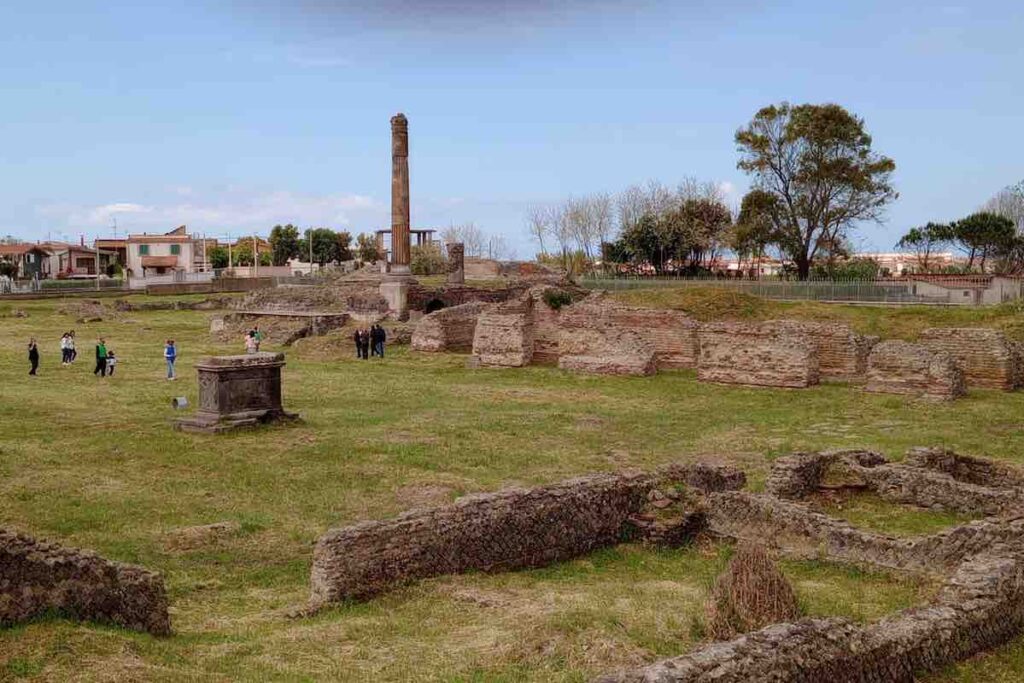
18 The Archaeological Park of Liternum
The Archaeological Park of Liternum, situated on the northern shores of Lake Patria in the municipality of Giugliano in Campania, represents one of the most evocative yet frequently overlooked historical sites in Southern Italy. Founded in 194 BC as a maritime colony, Liternum was established primarily to provide fertile land for the veteran soldiers who had served under the legendary Roman general Publius Cornelius Scipio, famously known as Scipio Africanus, during the grueling Second Punic War against Hannibal.
The city’s historical significance is inextricably linked to the figure of Scipio Africanus himself. After falling victim to political machinations and accusations of corruption by his rivals in the Roman Senate, the great general chose a life of voluntary exile in Liternum rather than facing his detractors in Rome. He spent his final years in a fortified villa within the colony, distancing himself from the city he had saved. According to the historian Livy, Scipio was so embittered by Rome's perceived betrayal that he requested to be buried in Liternum, supposedly leaving behind the famous epitaph: "Ungrateful fatherland, you shall not even have my bones." While the exact location of his tomb remains a subject of archaeological debate, the legend of the "Hermit of Liternum" continues to define the site’s cultural identity.
The urban layout of Liternum follows the classic Roman colonial model. Systematic excavations, particularly those conducted during the 1930s, brought to light the monumental center of the city. The Forum, which served as the social and political heart of the community, remains visible today. Bordering the Forum are the remains of the Capitolium, a temple dedicated to the Capitoline Triad—Jupiter, Juno, and Minerva—reflecting the religious devotion of the Roman veterans. Adjacent to these structures lies the Basilica, once used for judicial and commercial activities, and a small Roman theater from the Imperial era, which underscores the cultural sophistication the colony eventually achieved.
The strategic importance of Liternum was further enhanced in 95 AD with the construction of the Via Domitiana. This vital Roman road, commissioned by Emperor Domitian, connected the major port of Puteoli with the Appian Way at Sinuessa, facilitating trade and troop movements throughout the Phlegraean Fields.
Despite its initial prosperity, Liternum faced a slow decline during the late Roman Empire. The city suffered significantly during the Vandal raids of 455 AD. Furthermore, the progressive silting of the nearby lagoon transformed the surrounding landscape into a malarial swampland, leading to the gradual abandonment of the settlement by the 6th century. For centuries, the ruins were reclaimed by nature and forgotten.
Today, thanks to recent restoration efforts, the Archaeological Park of Liternum has been transformed into a protected historical and naturalistic area. It offers visitors a unique opportunity to walk through Roman history away from the bustling crowds of Pompeii. The park bridges the gap between the ancient urban ruins and the serene environment of the Lake Patria Nature Reserve, serving as a testament to the resilience of Roman engineering and the dramatic life of one of history’s greatest military commanders.