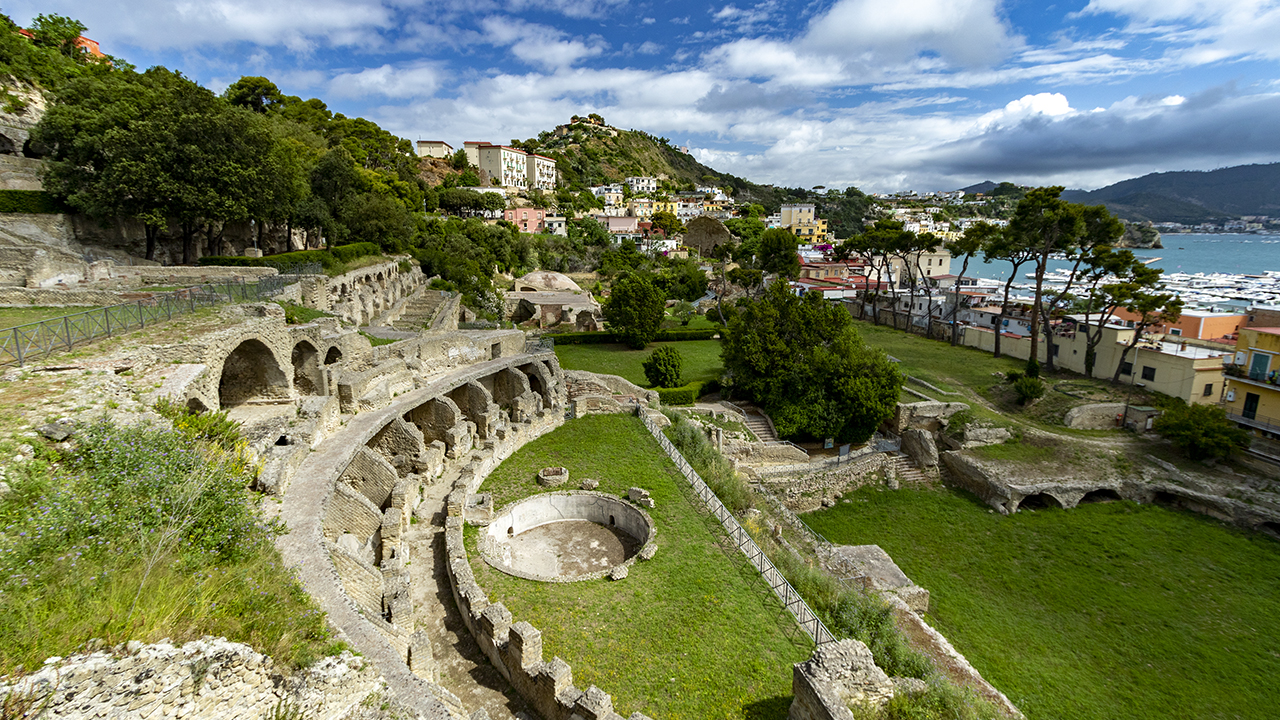
Often confused with a public bath complex, it was actually the Imperial Palatium. It extends across a hill with panoramic terraces. Here you'll see the "Temple of Echo" (actually a thermal bath), famous for its acoustics, and the remains of patrician residences with mosaics still visible. It's a labyrinth of nymphaeums, ramps, and gardens that slope down to the sea.
The Archaeological Park of the Baths of Baia is incorrectly called "Baths"; in reality, it is the remains of the Imperial Palatium, a residence so vast that it occupied an entire hillside. Baia was the "Las Vegas" of antiquity: a place of pleasure, unbridled luxury, and political scheming. The park is structured on several terraces connected by ramps and stairways, reflecting the skill of Roman engineers in bending the volcanic nature to the needs of imperial prestige.
The visit is divided into main sections. The Sosandra Sector, named after a famous statue discovered on site, is a residential complex with a semicircular theater-nymphaeum and splendid floor mosaics. Here, one can sense the elegance of daily life: porticoes opening onto the sea, hanging gardens, and fountains. Descending further, one encounters the large domed halls. The so-called Temple of Mercury (actually a frigidarium) is an architectural masterpiece: its hemispherical dome, featuring a central "oculus" similar to that of the Pantheon in Rome, is the oldest surviving large dome. The acoustics inside are legendary: a whisper against one wall can be clearly heard across the 21-meter diameter.
Another spectacular feature is the Venus Sector, home to the steam baths fueled by the hot fumes from underground. The use of "pila" (brick pillars) to heat the floors is visible here in nature-themed educational sections. Strolling through this park today means losing yourself among fig trees growing upside down (like the famous hanging fig tree in the Temple of Echo) and structures that seem to defy gravity. It is a place where wild nature and imperial architecture have found a sublime aesthetic compromise, making it one of the most romantic and evocative sites in Europe.