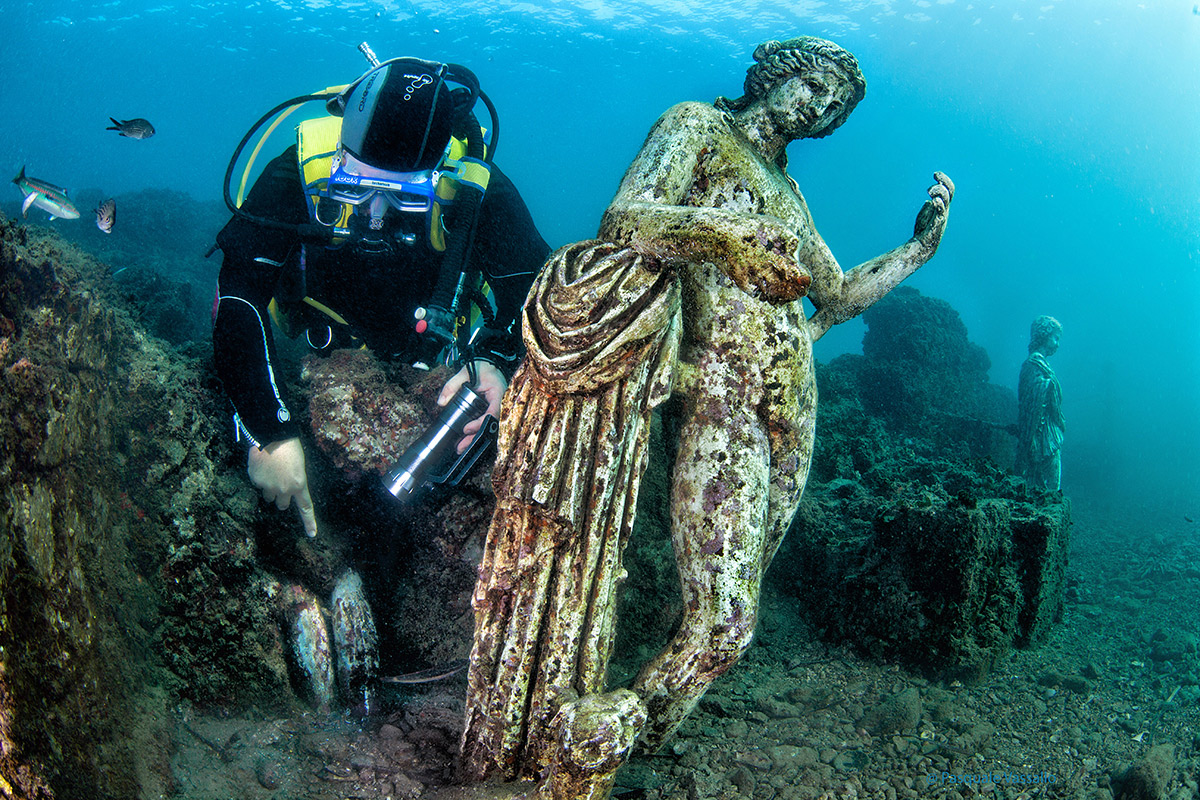
The "submerged Pompeii." Due to bradyseism, the ancient coastline has sunk by approximately 5-7 meters. It can be visited by glass-bottom boats or by diving. You'll see the Nymphaeum of Punta Epitaffio, paved Roman roads (the Via Herculanea), and the remains of the Villa dei Pisoni. It is one of the few marine archaeological parks in the world.
The Baia Underwater Park is the only example in the world of an entire Roman city perfectly preserved below sea level. Due to negative bradyseism (the subsidence of the ground caused by volcanic movements), the Roman-era coastline has sunk by approximately 5-7 meters. What we see today is a sort of Phlegraean "Atlantis," protected from erosion and time by the waters of the gulf. The site is a Special Area of Conservation and can be visited by glass-bottom boats (Cymba & Lomar), snorkeling, or guided scuba diving.
The heart of the park is the Submerged Nymphaeum at Punta Epitaffio. Originally, it was a richly decorated banquet hall belonging to Emperor Claudius. Visible beneath the water are replicas of the statues (the originals are in the Castle) depicting Ulysses and his companion offering wine to the Cyclops Polyphemus. Seeing these figures surrounded by schools of fish and seaweed is a surreal experience. Not far away is the Via Herculanea, the ancient Roman road paved with flagstones that connected the commercial port to the residential area. You can still make out the cart ruts and the remains of the shops (tabernae) that once lined the street.
Continuing towards the Villa dei Pisoni, you enter what was once the home of one of Rome's most powerful families, confiscated by Nero after a failed conspiracy. Here, vast porticoed courtyards, private baths, and fish-farming ponds (piscinae) extend, once a symbol of extreme wealth. The mosaic floors are incredibly intact; the black and white geometric designs stand out clearly through a diving mask. The Underwater Park is more than just archaeology; it's a living ecosystem where marine life has colonized the marble and brick, creating a unique symbiosis between human history and nature. It's a silent testament to the fragility of the Phlegraean Fields and the past grandeur of Baia.