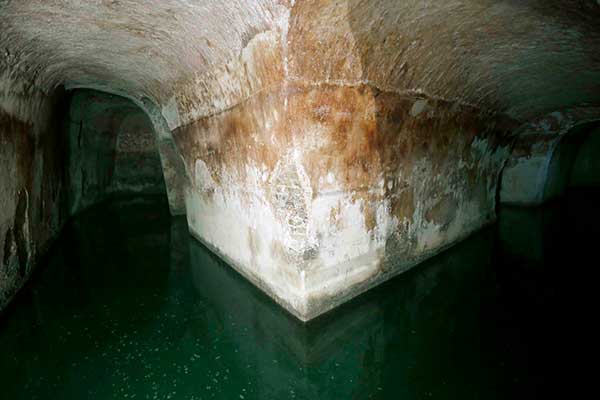
A colossal cistern carved into the side of the Miseno hill. It served to supply water to the ships of the Classis Misenensis. Its naves and pillars carved directly into the tuff create a cathedral-like atmosphere.
At the foot of the Miseno hill, almost hidden between modern houses and the beach, lies the Dragonara Cave. It is not a natural cave, but a colossal cistern carved entirely out of the tuff, approximately 60 meters long and 7 meters wide. Its structure is divided into five naves by massive pillars left in the tuff during excavation. It is a masterpiece of hydraulic engineering by subtraction: instead of building walls, the Romans removed the rock to create a hollow space capable of holding millions of liters of water.
The Dragonara had a vital function: it served as a water reserve for the Classis Misenensis, the imperial fleet stationed in the port of Miseno. Roman ships, before departing for their missions in the Mediterranean, would replenish their fresh water here. Inside the cistern, traces of the hydraulic plaster (cocciopesto) that made the walls waterproof are still visible. The atmosphere inside is cold and solemn, similar to that of an underground cathedral. Light enters only from the entrance and a few upper vents, creating shadows that enhance the geometry of the pillars. The bottom of the cistern is often partially flooded due to rainfall or seepage, creating the image of a still body of water that seems to still await the emperor's ships. It is a site that speaks to military logistics and a state organization capable of ensuring vital resources in every corner of the known world.